Technical Architecture
Hardware Implementation
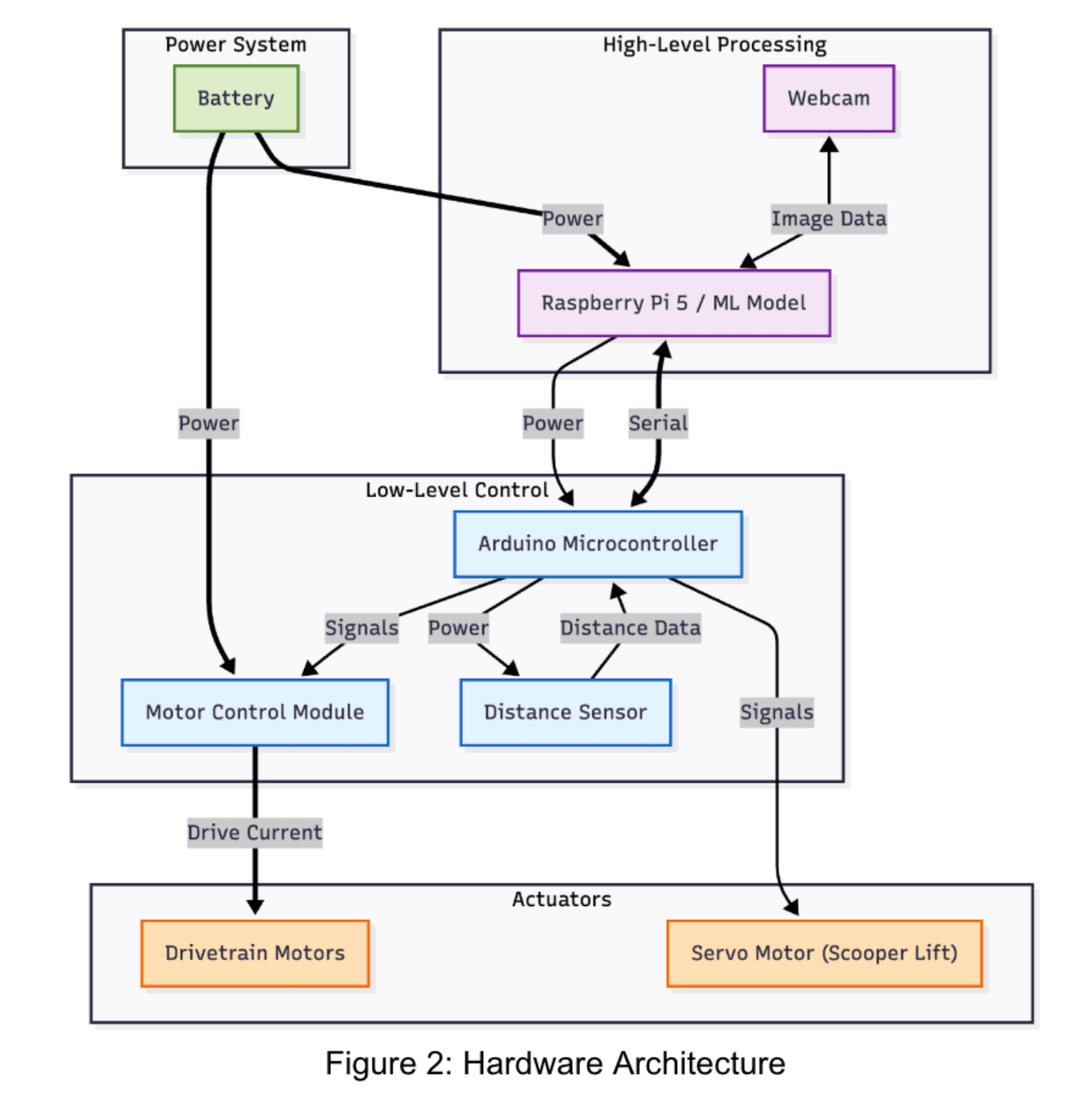
The DuneBroom robot was engineered using a modular hardware stack defined by specific performance constraints. The system is organized into four functional subsystems.
Power System
A high-capacity battery serves as the central power source, distributing power to the motor control module and the Raspberry Pi. The power budget was calculated to sustain continuous autonomous operation for over 1 hour on a single charge.
High-Level Processing
This subsystem handles the computationally intensive tasks required to classify objects in front of the robot as nature versus trash.
Raspberry Pi 5
Serves as the robot's primary computer. Executes the YOLOv8 ML model to classify objects as "trash" or "nature". Makes high-level navigation decisions and sends commands via serial connection to the Arduino.
Webcam
Connected directly to the Raspberry Pi. Captures a high-resolution image only when triggered, providing the visual data necessary for the ML model to differentiate between trash and natural elements.
Low-Level Control
This subsystem manages real-time sensor data and hardware protocols.
Arduino Microcontroller
Acts as the hardware interface. Manages real-time input/output by reading data from the ultrasonic distance sensors and sending signals to the motor control module and the scooper's servo motor.
Distance Sensors
Ultrasonic sensors connected to the Arduino continuously monitor the path for obstacles within a 3-inch range. These sensors serve as the hardware "trigger" that wakes the vision system.
Motor Control Module
An intermediate driver that interprets signals from the Arduino and uses power from the battery to control the motors.
Actuators
This subsystem converts electrical signals into physical motion to navigate and clean the beach.
Drivetrain Motors
High-torque DC motors operating between 200-300 RPM. These motors drive a tank-tread chassis designed to maintain traction on soft sand while achieving a speed of approximately 2 km/hr.
Servo Motor (Scooper Lift)
Controls the vertical articulation of the custom 3D-printed scooper. Lowers the mechanism to collect identified trash and raises it to avoid drag or navigate over natural obstacles.